This article delves into the critical aspects of Apache Kafka security and how KafkaGuard can significantly enhance your compliance posture. We will explore the inherent security features of Apache Kafka, the challenges in securing real-time data pipelines, and the essential architectural components for a robust security framework.
Understanding Apache Kafka Security
Overview of Apache Kafka Security Features
Apache Kafka is a powerful distributed streaming platform, and understanding its security features is paramount for any organization leveraging its capabilities. KafkaGuard is a robust CLI tool designed to scan your Kafka clusters and rigorously evaluate them against a comprehensive set of production-ready controls. It thoroughly inspects configurations related to SASL, SSL/TLS, ACLs, replication, and data retention, ensuring your Apache Kafka cluster adheres to stringent security best practices.
| Feature | Details |
|---|---|
| Controls Evaluated | 55 (security, reliability, and operational aspects) |
| Supported Authentication Methods | SASL (PLAIN, SCRAM-SHA-256/512), SSL/TLS, mTLS, Kerberos |
| Cluster Mode Detection | KRaft and Confluent Platform |
| Scan Completion Time | Under 90 seconds |
KafkaGuard efficiently detects cluster modes like KRaft and Confluent Platform to activate relevant controls.
Importance of Kafka Security in Real-Time Data Processing
The criticality of Kafka security in real-time data processing cannot be overstated, as Apache Kafka powers mission-critical data pipelines for thousands of companies globally. For instance, if your Kafka clusters process sensitive cardholder data, they inherently fall under the strict scope of PCI-DSS, necessitating robust encryption in transit, stringent access controls, and comprehensive audit logging. Unfortunately, many Kafka clusters often fall short of these fundamental security requirements before any audit preparation even begins, highlighting the urgent need for automated and efficient security solutions.
Securing these vital Kafka clusters typically involves a meticulous and complex process:
| Security Task | Effort / Complexity |
|---|---|
| Manual review of configurations | Can often span several days or even weeks |
| Careful checking of Access Control Lists (ACLs) | Can often span several days or even weeks |
| Mapping various settings to stringent compliance requirements | Can often span several days or even weeks |
Key Components of Secure Kafka Architecture
A truly secure Kafka architecture integrates several critical components to safeguard your streaming data. It is imperative that inter-broker communication is always encrypted to prevent eavesdropping, and that ZooKeeper authentication and ACLs are properly enabled to secure metadata. Client authentication is a non-negotiable requirement, and SSL endpoint identification should be meticulously configured to prevent man-in-the-middle attacks. Utilizing security protocols like SSL or SASL_SSL is fundamental, and all monitoring endpoints must also be securely protected. Furthermore, robust audit logging should be enabled with a log retention policy for at least 90 days to ensure regulatory compliance, alongside implementing encryption at rest and mutual TLS for inter-broker communication as essential safeguards.
| Security Component | Purpose / Description |
|---|---|
| SASL Authentication | For robust client and inter-broker communication. |
| SSL/TLS Encryption | To protect data in transit. |
| ACL Authorization | To manage user permissions effectively. |
Ensuring Compliance with KafkaGuard
How KafkaGuard Supports Regulatory Compliance
KafkaGuard plays a pivotal role in achieving and maintaining regulatory compliance for your Apache Kafka clusters. It rigorously scans your environment against 55 critical controls spanning SOC 2, PCI-DSS, and ISO 27001 requirements. This powerful tool automates the otherwise tedious and error-prone process of mapping Kafka configurations to specific compliance requirements, such as ensuring TLS encryption on all listeners (PCI-DSS Req 4.1), enabling SASL authentication (PCI-DSS Req 8.1), and configuring robust ACL authorization (PCI-DSS Req 7.1). KafkaGuard also verifies SSL certificate validity and confirms replication for data integrity, providing comprehensive coverage for your compliance needs.
Beyond PCI-DSS, KafkaGuard comprehensively addresses SOC 2 requirements, verifying that only authorized principals can read from Kafka topics and ensuring inter-broker communication is properly encrypted. It actively detects misconfigured ACLs and prevents unrestricted access from wildcard ACLs, which are common sources of security vulnerabilities. By providing this detailed analysis, KafkaGuard significantly strengthens your overall Kafka security posture and helps maintain stringent data protection standards across your real-time data pipelines. The platform generates audit-ready reports in a mere 90 seconds, drastically reducing the time and effort traditionally required for compliance assessments.
Each finding comes with severity, the exact control it maps to, and a copy-paste remediation step:
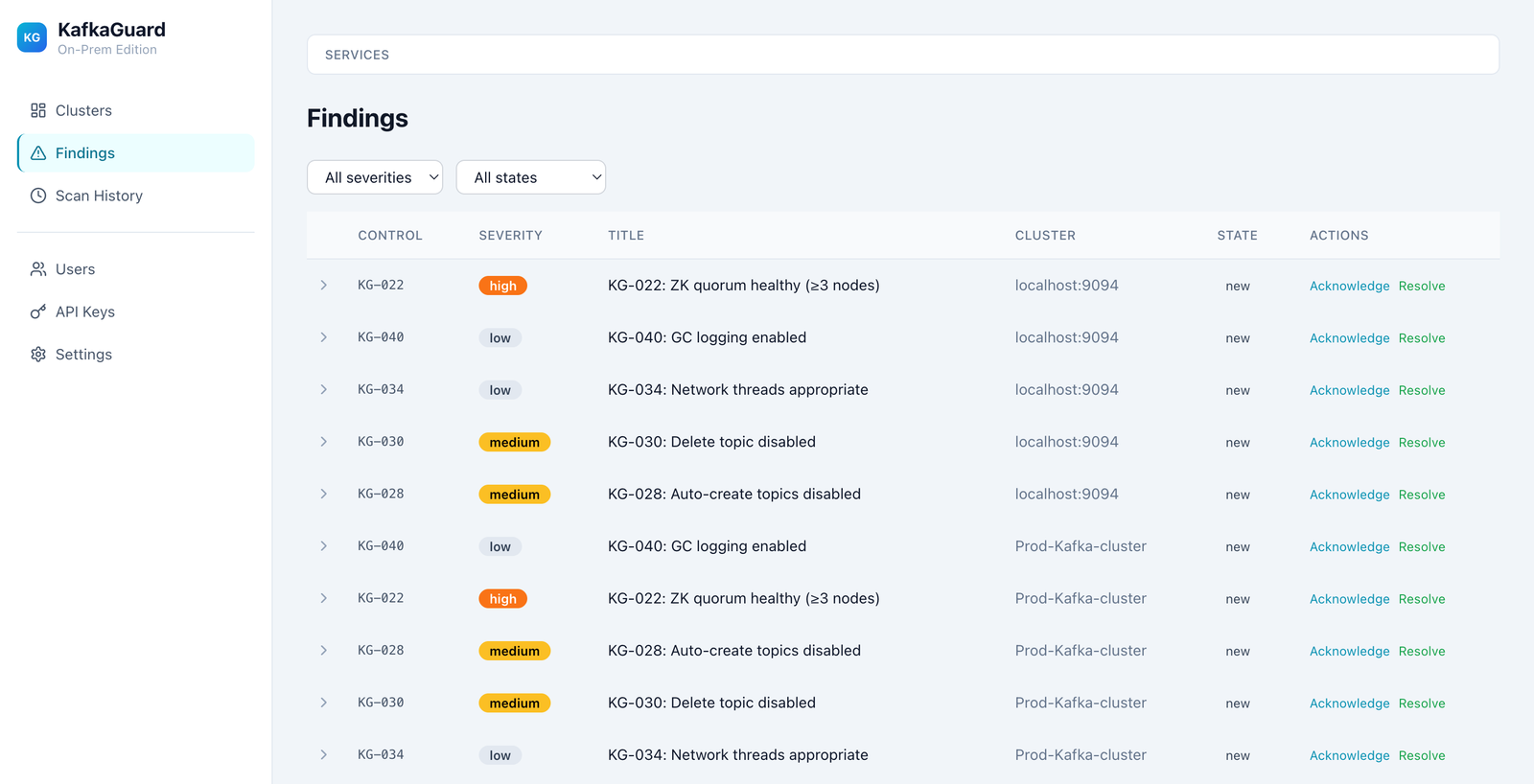
At a glance, every finding gives you:
- Severity — critical, high, medium, or low, so you know what to fix first
- Mapped control ID — the exact PCI-DSS, SOC 2, or ISO 27001 requirement it satisfies
- Evidence — the actual configuration value pulled from your cluster
- Remediation — a concrete CLI command or config change to resolve it
Audit Capabilities of KafkaGuard for Apache Kafka
KafkaGuard's robust audit capabilities are designed to streamline your compliance reporting. It generates comprehensive, audit-ready reports in multiple formats, including JSON, HTML, PDF, and CSV, offering unparalleled flexibility. The HTML reports provide an executive summary, a clear compliance score, detailed findings with actionable remediation guidance, and precise mapping of each finding to PCI-DSS, SOC 2, or ISO 27001 requirement IDs. This structured approach simplifies the process for your security team and auditors.
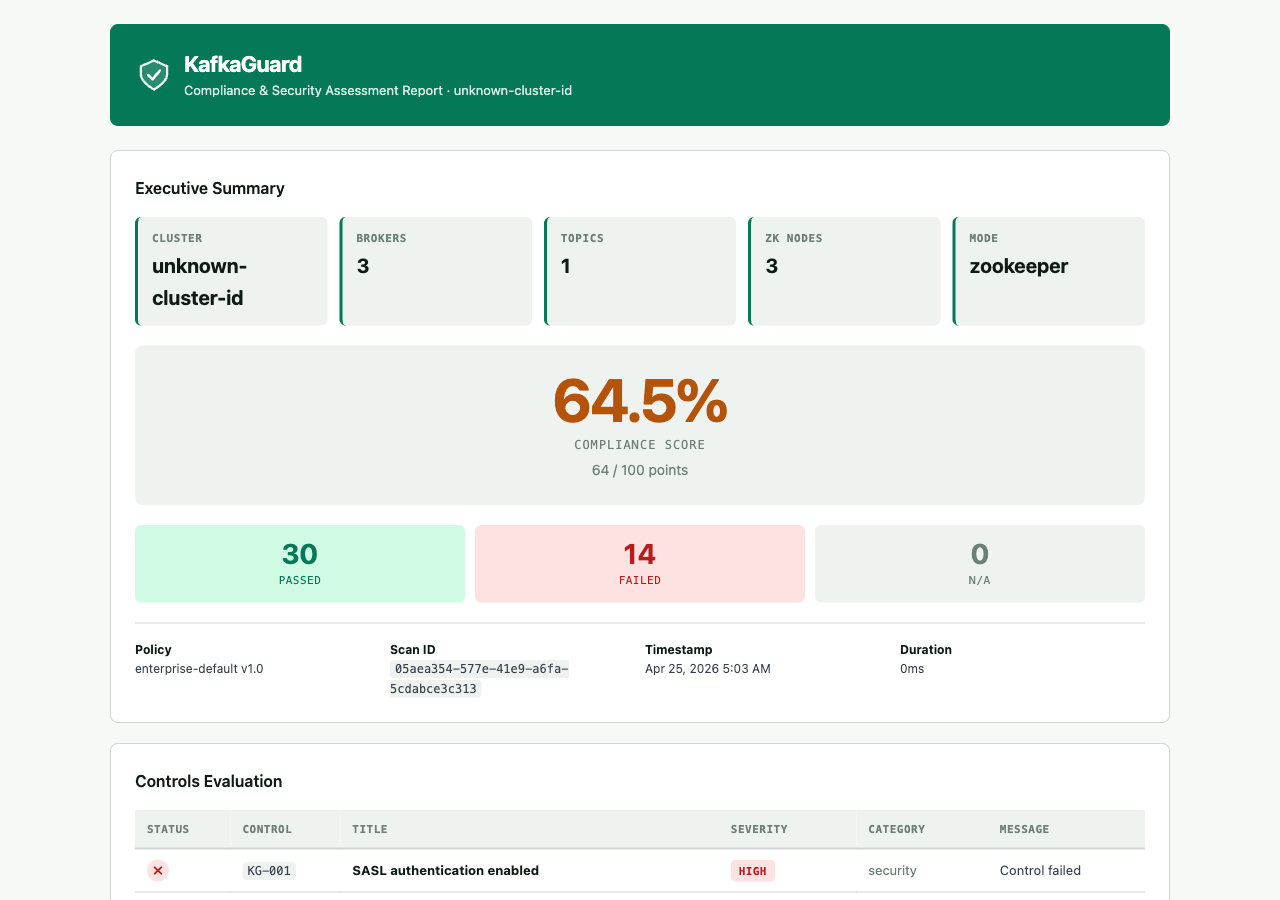
Reports are produced in four formats, each suited to a different audience:
- HTML — shareable, human-readable report with an executive summary and compliance score
- PDF — auditor-ready document with control mappings, remediation steps, and evidence
- JSON — machine-readable output for dashboards, SIEMs, and automation
- CSV — flat export for spreadsheets and evidence tracking
PDF reports further enhance the audit process by including an executive summary with the compliance score, detailed PCI-DSS requirement mappings for every finding, specific remediation steps with direct CLI commands, and crucial evidence data gathered from your Apache Kafka cluster. For SOC 2 compliance, reports meticulously detail each control with a PASS/FAIL/N/A status, pre-mapped SOC 2 CC control IDs for every finding, and explicit remediation steps for any identified failures, ensuring complete transparency and ease of resolution. KafkaGuard On-Prem further offers a self-hosted dashboard for centralized scan tracking, trend analysis, multi-cluster comparison, and integration with Slack/Teams for proactive alerting.
Best Practices for Achieving Compliance
To achieve robust compliance with Apache Kafka using KafkaGuard, adhering to best practices is essential. For PCI-DSS compliance, it is recommended to utilize the enterprise-default or finance-iso policy tiers within KafkaGuard, as both include comprehensive PCI-DSS control mappings.
Triage findings by severity so the right things get fixed at the right time:
- Critical / High — must be remediated before any audit window
- Medium — fix promptly; if not immediately feasible, document a compensating control
- Low — record in your risk register with a defined remediation date
After implementing remediations, a subsequent KafkaGuard scan should be performed to verify that all fixes are effective and that your Apache Kafka cluster is now compliant. The most impactful hardening steps are usually:
- Replace wildcard ACLs (e.g.,
User:*) with explicit, principal-based ACLs to tighten access control - Enable audit logging by configuring
authorizer.class.name - Set log retention to at least 90 days for compliance-sensitive topics (
log.retention.hours=2160) - Disable deprecated TLS versions by setting
ssl.enabled.protocols=TLSv1.2,TLSv1.3 - Protect critical topics with
min.insync.replicas=2andacks=allto prevent data loss
Implementing KafkaGuard for Secure Kafka Pipelines
Integrating KafkaGuard with Confluent Cloud
Integrating KafkaGuard with Confluent Cloud streamlines your security and compliance efforts for Apache Kafka. KafkaGuard intelligently auto-detects the Confluent Platform cluster mode, automatically activating the appropriate controls to ensure comprehensive coverage. This capability is crucial for maintaining a strong security posture within your Confluent environment, providing tailored security assessments without manual configuration. Our product ensures that your Confluent Kafka deployments adhere to strict compliance requirements, fortifying your real-time data pipelines.
Security Monitoring with KafkaGuard
KafkaGuard offers robust security monitoring capabilities, particularly with its On-Prem solution. This provides a self-hosted dashboard for centralized scan tracking and trend analysis, essential for continuous improvement in Kafka security. The dashboard presents a multi-cluster view, detailing compliance scores, findings, and remediation guidance, enabling proactive security operations.
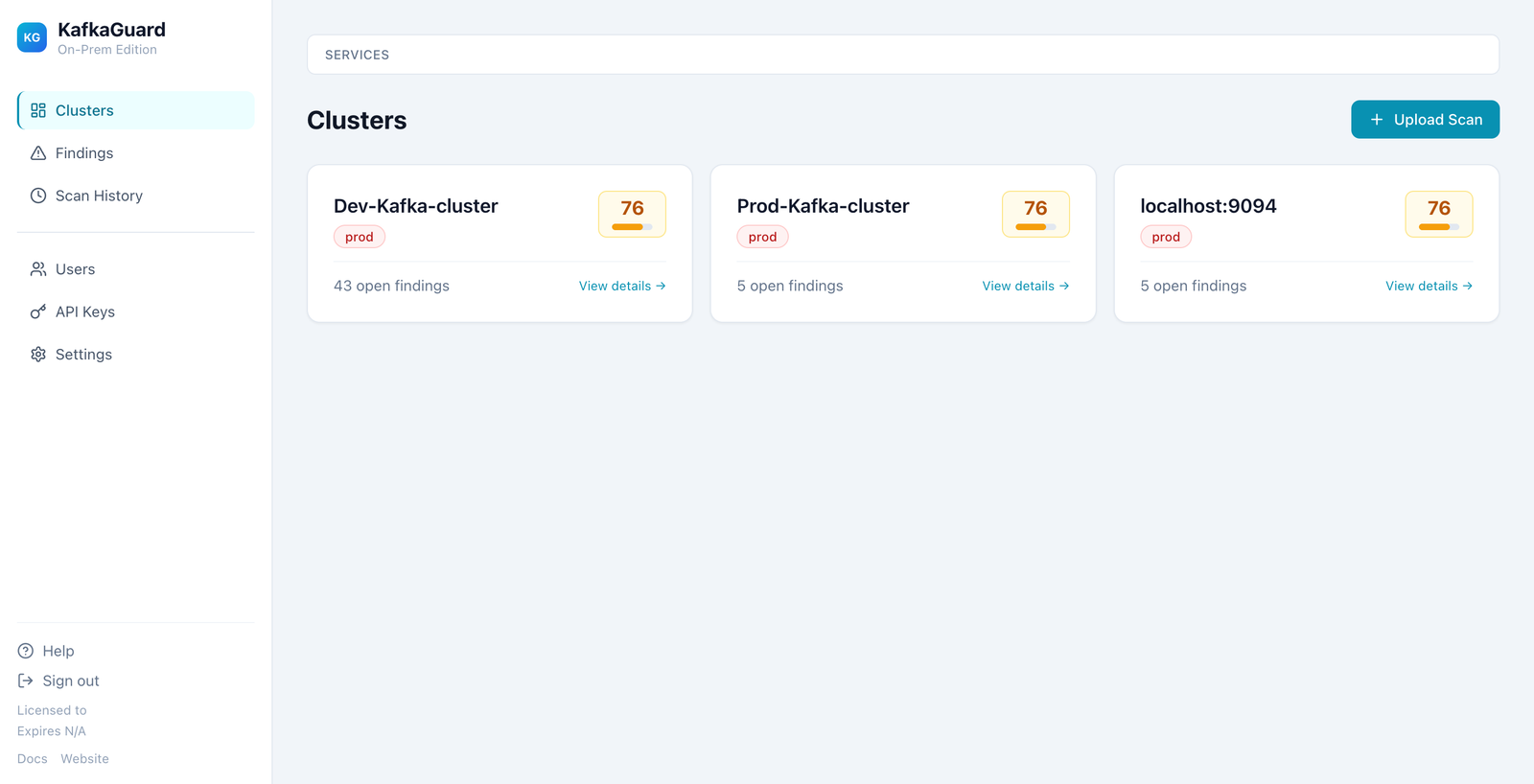
The self-hosted dashboard gives security and compliance teams a single place to:
- See every cluster at a glance — compliance score, last scan, and open findings per cluster
- Track trends over time — score history and which policy each scan used
- Get alerted proactively — Slack/Teams notifications on new findings
- Prove who did what — every scan and acknowledgment is captured in an audit log
Every action within the dashboard, from scan execution to finding acknowledgment, is meticulously tracked in an audit log, providing a transparent trail for compliance teams and aiding in comprehensive audit processes.
Real-Time Compliance Auditing with KafkaGuard
KafkaGuard excels in providing real-time compliance auditing for your Apache Kafka deployments. It completes a full security scan in under 90 seconds, a critical feature for fast-paced development environments. This rapid scanning capability allows for seamless integration into CI/CD pipelines, performing vital security checks with every new release.
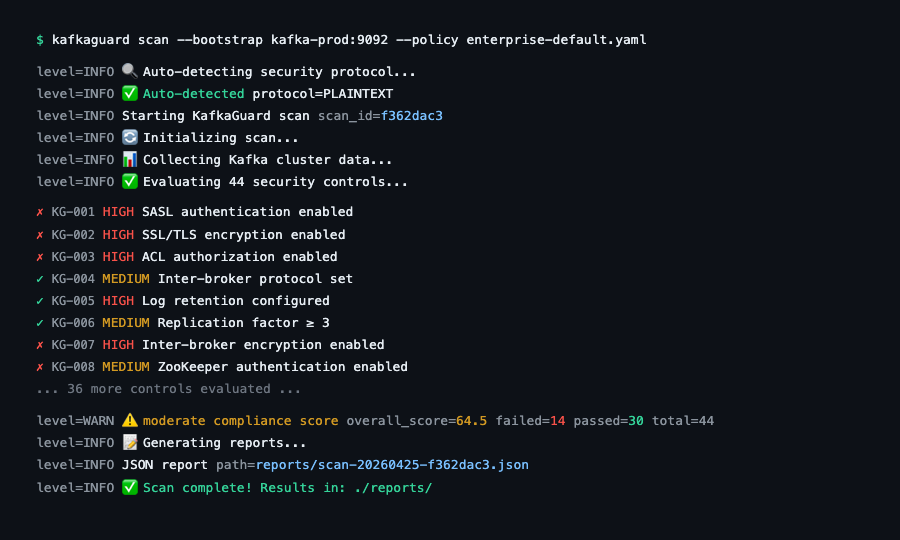
This makes KafkaGuard a natural fit for automated pipelines:
- Runs in CI/CD — gate every release on a fresh security scan
- Fails the build on regressions — a failed scan returns a non-zero exit code, blocking the pipeline
- Streams live results — control evaluation prints to the terminal as it runs, for immediate feedback
- No agents required — point it at a bootstrap server and go
Should a scan fail, KafkaGuard returns a non-zero exit code, automatically blocking pipelines on security regressions, thereby preventing insecure configurations from reaching production.
Best Practices for Apache Kafka Security
Strategies for Enhancing Kafka Security
Enhancing Kafka security requires a multi-faceted approach, starting with fundamental best practices. It is crucial to enable SASL authentication on all brokers, employ robust SSL/TLS encryption for data in transit, and implement fine-grained ACL authorization. The essentials KafkaGuard checks for include:
- Authentication — SASL enabled on all brokers, using strong mechanisms (SCRAM-256, SCRAM-512, or GSSAPI); never default or weak passwords
- Authorization — fine-grained ACLs with no wildcards (
User:*grants unrestricted access) - Encryption in transit — SSL/TLS on every listener, with
SSLorSASL_SSLas the security protocol - TLS hygiene — protocol at least 1.2 (deprecated 1.0/1.1 disabled), certificates not expiring within 30 days, and SSL endpoint identification configured
- Inter-broker & metadata — encrypted inter-broker communication, plus ZooKeeper authentication and ACLs enabled
- Operational surface — all monitoring endpoints secured to protect sensitive operational data
Data Privacy Regulations and Kafka Compliance
When Apache Kafka carries sensitive customer data, processes payments, or handles healthcare records, it falls under the stringent scope of various data privacy regulations and requires robust compliance. Such scenarios often necessitate SOC 2 Type II audits. PCI-DSS 4.0 and SOC 2 explicitly mandate the disabling of deprecated TLS versions (e.g., TLS 1.0/1.1). For instance, if a payments topic contains payment event data, it must be retained for 7 years under PCI-DSS requirements. Furthermore, SOC 2 CC7.2 requires irrefutable evidence that you can detect who accessed what, necessitating comprehensive audit logging for all Kafka topics. Data retention policies, such as log.retention.hours=2160 (90 days), must be rigorously enforced for all compliance-sensitive topics to meet regulatory compliance.
Continuous Improvement in Kafka Security Posture
KafkaGuard enables continuous improvement in your Kafka security posture by allowing teams to run scans continuously within CI/CD pipelines. The on-prem dashboard meticulously tracks every scan in a history timeline, showing score trends and the policies used, providing valuable insights into your security evolution.
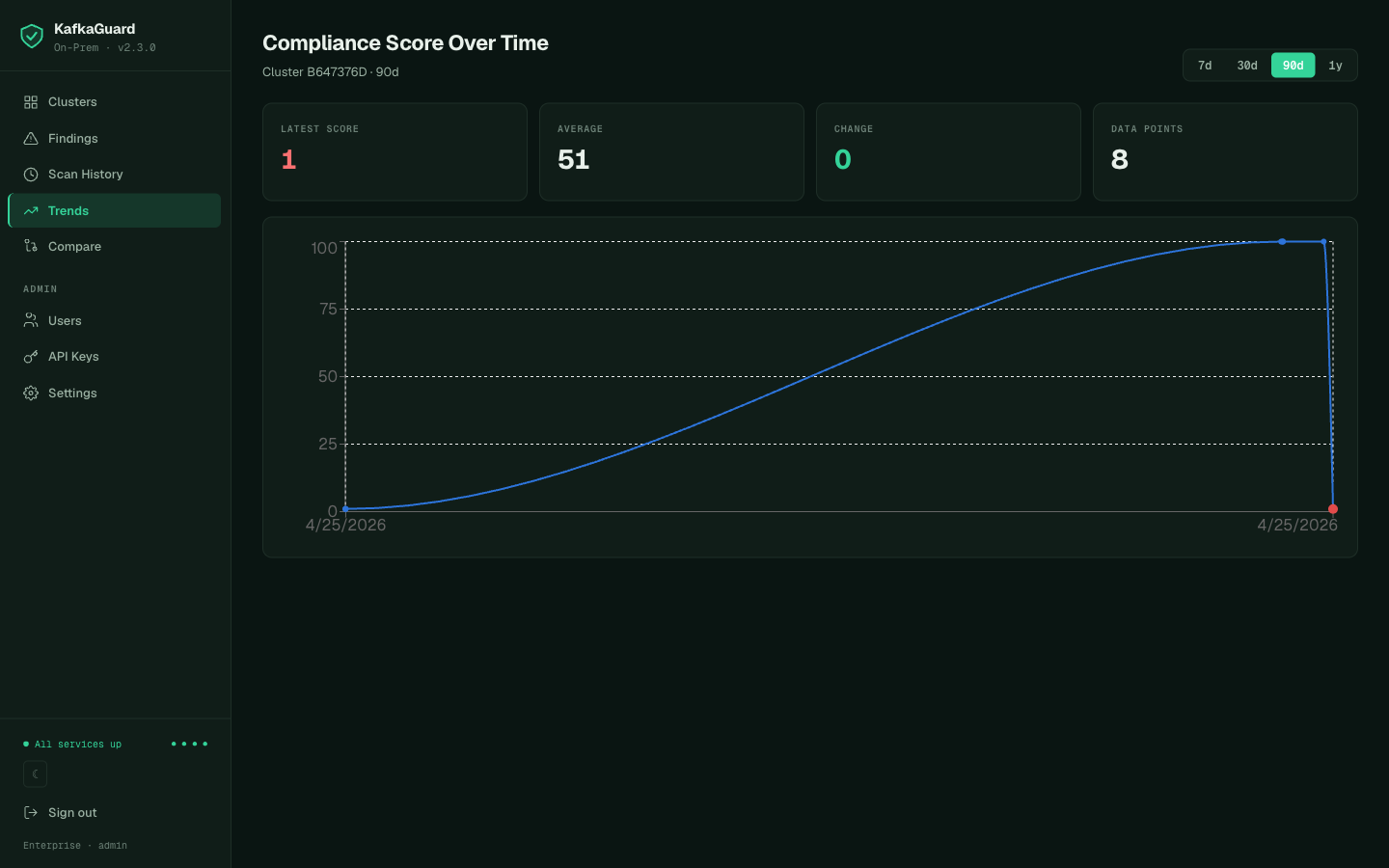
After addressing critical and high-severity failures, re-running scans is essential to verify remediation efforts and confirm that your Apache Kafka cluster is compliant. KafkaGuard also allows for the creation of custom policies with specific controls and severity mappings, enabling you to tailor security assessments to your unique organizational needs.
The Community tier of KafkaGuard is free forever, covers all 55 controls, and produces comprehensive HTML and JSON reports — making it an invaluable tool for maintaining robust Apache Kafka security. Grab the binary from GitHub Releases and scan your first cluster in under 90 seconds.